


-
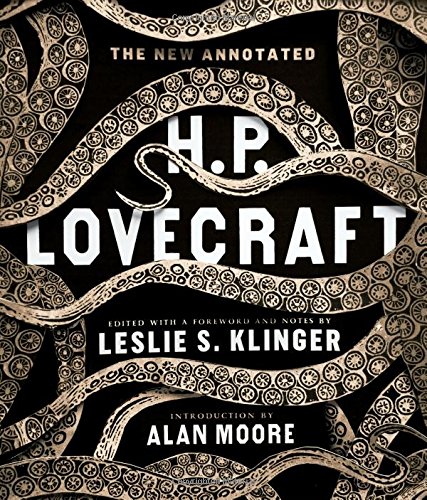
I've been anxiously awaiting Les Klinger's The New Annotated Lovecraft, which I'll dive into as soon as my Vandermeerism wears off.front cover of the New Annotated HP Lovecraft
Happened to catch the modern novelist, Charles Baxter's, screed on Lovecraft disguised as a "review" in the very intellectual New York Review of Books (12/4/2014).
Among other predictable complaints about Lovecraft (terrible writer with no sense of style, appeals only to adolescents, a racist, shut in, et al) Baxter tries to understand why Lovecraft is still so popular and comes up with the partronizing notion that Lovecraft only appeals to like-minded people (morbid, paranoid, suspicious).
Oh, brother...
Here are few "gems" from this so-called review (little mention of Les Klinger's annotations; no mention of Alan Moore's introduction).
"His narrators cannot calm down; the fever never breaks. Accordingly, simple human decency, kindness, and generosity have no place anywhere in the stories. Their emotional range is limited to dread on one end of the spectrum and hysteria on the other"."In my judgment, Lovecraft’s true staying power as a writer can be attributed to his chilling depictions of death-in-life, the one subject in which he could claim genuine expertise".
"After both world wars and the atrocities of recent history, Lovecraft’s horrors seem like quaint, construction-paper toys created by someone who did not get outside much—he never went to Europe—and who built his puppet theaters out of whatever was lying around."
Thankfully, we have S.T. Joshi's brilliant reply to Charles Baxter's review. Joshi is a Lovecraft authority and has written extensively on the "Weird Tale" tradition that Lovecraft drew on as a writer. He's also written the definitive biography of Lovecraft (I Am Providence).

front page of STJoshi.org
Here are some lovely quotes from this well-written riposte to Baxter's awful review. I chose comments that focused on racism, the adolescent claim and his (Lovecraft's) connection to the Weird Tale tradition in American Literature:
"Charles Baxter appears determined to pigeonhole Lovecraft as a writer of interest only to “adolescents.” While it is true that a substantial number of Lovecraft devotees initially read him as adolescents, a fair number of these fans grow up to be reasonably mature writers in their own right who continue to draw upon Lovecraft’s writings for aesthetic inspiration"
"Baxter goes on to assume—based on a stray comment made early in his career (“Adulthood is hell”)—that Lovecraft himself remained an arrested adolescent. In fact, he was largely successful in overcoming the severe psychological damage resulting from his early upbringing (he was raised by two parents who were borderline psychotics) and became a surprisingly well-adjusted and outgoing individual, and one who exhibited a keen interest in the world around him."
"There is also the question of exactly how much racism enters into Lovecraft’s fiction. Baxter maintains that it is central. Another reviewer of the Klinger book—John Gray, writing in the New Republic—offers a different opinion: “Fortunately, the core of his work has nothing to do with his social and racial resentments.”[7] I am inclined to agree with Gray. Such things as atheism,[1] devotion to science, and love of the past are all far more central to both his philosophy and to his fiction than racism."
"The upshot of all this is that Lovecraft developed, in the course of a relatively short career spanning less than twenty years, a highly coherent aesthetic of the weird and developed a prose style that he believed was appropriate to its expression. Whatever one may think of Lovecraft’s prose, I would suggest to Mr. Baxter that he be a little less intolerant when assessing work that doesn’t accord with his own presuppositions."
-

I often like to browse at Dark Delicacies, a horror-themed bookstore in Burbank, to find interesting and unusual books that just don't show up at other stores. Sue and Del Howison just moved their store to a larger location and have done a wonderful job of displaying their collection of small press horror and related items.
A graphic novel adaptation of H.P. Lovecraft's most famous story "Call of Cthulhu" caught my eye one Sunday. Actually, several books caught my eye but I could only afford one book and the artwork in this graphic novel looked intriguing.
After getting it home, I got settled in my reading spot and started in. And, man, am I glad I bought this book. Swiss artist Michael Zigerlig's artwork and layout is superb. Plus, he does an excellent job of trimming away at some of Lovecraft's over-written prose to lay out the bones of this weird tale.
I think one of the best aspects of Lovecraft's writing is his sense of mood. Weird and uncanny are accurate descriptions of the scenes in most of Lovecraft's works and none more so than in Call of Cthulhu. In Zigerlig's hallucinatory, spidery drawings (all in high-contrast black and white) the sense of dread and loss of reason so present in the story are beautifully captured. Scenes like the police discover of the Cthulhu cult in a swampy forest outside of New Orleans are truly weird in Zigerlig's drawings. And I particularly like the rhythm he establishes by using large and smaller boxes of drawings. Sometimes the box vanishes entirely and the entire page is used to great effect. This adds to the feeling that structure/reason is breaking down very much like it does in the story.

These illustrations are certainly the work of someone who knows Lovecraft and his works through and through. The attention to detail, especially in period clothing and furniture detail is marvelous. And, of course, his use of contrast and shadow is masterful. In Zigerlig's artwork the play of light and dark itself could tell the story.
I just loved this adaptation. It counts as one of my favorite versions of the story, right next to the excellent amateur film adaptation of "Call of Cthulhu" done in an Art Deco style and released on DVD a few years ago. Definitely pop it onto your Netflicks cue.
If had any criticisms of Zigerlig's "Call of Cthulhu" it would be that he uses dialog boxes perhaps too much. In an effort to retain some of Lovecraft's writing, he can crowd a scene with dialog or description that would work better if he completely relied on the visual. Still, it's a tough job working your way through Lovecraft's prose and Zigerlig has done a very good job overall.
I highly recommend this graphic novel. As it is we are in a renaissance of graphic novel art both by major and minor publishers. I commend Transfuzion Publishing and in particular, Gary Reed, for putting this book together so well and for selling it cheap ($9.99).
PS there's an intro by H.R. Giger, but it's middling and inconsequential. It will sell copies, but he probably spent 5 mintues writing it. Skip it and go right to the story.
Showing posts with label Lovecraft. Show all posts
Showing posts with label Lovecraft. Show all posts


Subscribe to:
Posts (Atom)


